
In this guide · 8 sections
Volleyball is the cheapest team sport to start a league in. One gym, two nets, twelve players a court, and no officials required if your teams can call their own lines. It is also the sport where the difference between a league people love and one that quietly dies is almost entirely about format and division honesty.
This is the order to make the decisions in — format, courts, match structure, divisions — and the operational details that make league night run itself.
Step 16s, 4s, or doubles
Every other decision follows from this one. It sets how many players each team needs to find, how many courts you need, and who your league is actually for.
Six a side, co-ed
The default rec format and the easiest to fill. Six on the court means a roster of ten to fourteen absorbs no-shows without cancelling, and it is the version most adults played in gym class.
Step 2Co-ed ratios and how to say them
Almost every recreational co-ed league runs a minimum-women rule rather than a fixed split, because a fixed split means a team with four women and two men cannot play a legal lineup. The standard is:
| On court | Common rule | Playing short |
|---|---|---|
| 6 | At least 2 women on the court at all times | Play with 5 and a legal ratio, never 6 with an illegal one |
| 4 | At least 1 woman on the court | Play 3 rather than break the ratio |
| Serving order | Alternate where the roster allows | Not enforced in most rec leagues |
Write the rule as a minimum, not a split. A minimum lets a team field whoever showed up; a split sends people home.
Then write the part everybody forgets: what happens when a team is short. The workable version is that a team may play with one fewer player than the format allows while keeping the ratio, and the empty rotation slot is a loss of rally when it comes up to serve. That is a real rule with a real consequence, and it means the match still gets played.
Step 3Courts, nets, and the setup tax
Volleyball has a cost nobody warns you about, and it is not money: it is the twenty minutes at each end of the night spent putting nets up and taking them down.
- Find out whether the facility sets up nets, or whether you do. This changes your booking by 30–40 minutes every single night.
- Ask what net system it is. Ratchet systems tension in two minutes; rope-and-pulley setups eat ten.
- Confirm net heights and who adjusts them. Co-ed rec usually plays the men's height of 2.43m or a compromise around 2.35m — pick one and stop relitigating it.
- Check antennae, referee stand, and whether the scoreboard actually works. Bring a flip scorer as backup, always.
- Count how many courts fit with real safety runoff, not how many net anchors exist in the floor.
Book the gym for the block including setup and teardown. Every league that books 7 to 9 for two hours of volleyball ends up with 90 minutes of volleyball and a janitor waiting at the door.
How many courts you need
Two courts running in parallel handle four teams at a time. With a two-hour block and 25-minute match slots, two courts gets you through eight teams playing three matches each — that is a full league night on one gym rental.
| Teams | Courts | Block length | Matches per team |
|---|---|---|---|
| 4 | 1 | 2 hours | 3 |
| 6 | 2 | 2 hours | 2–3 (one bye rotation) |
| 8 | 2 | 2 hours | 3 |
| 12 | 3 | 2.5 hours | 3 |
| 16 | 4 | 2.5 hours | 3 |
Based on 25-minute slots: two sets to 25 with a cap, plus changeover. If your facility only has two courts, split the league into an early and late wave rather than cutting matches.
Step 4Match format and rally scoring
Rec volleyball needs a match format that finishes on time, because your gym block is fixed and the next court is waiting. That means capped sets and a hard horn.
- Two sets to 25, cap at 27. The standard rec format. Rally scoring, win by two, but the cap means no set runs forever. Teams can split 1–1 and that is a fine result.
- Best of three with a short third. Two sets to 25 then a deciding set to 15, only if your slots are 35 minutes or longer. It is the better competition and the worse schedule.
- Timed sets. Play to 25 or until the horn, whichever comes first, highest score wins. Ugly, and absolutely necessary when you have four teams waiting for the court.
The standings question
If teams can split sets, a win-loss record does not describe the season — so count sets, not matches. Most rec volleyball leagues rank on set wins, with total points scored as the first tiebreaker. It rewards the team that wins 25–12, 24–26 over the team that wins 25–23, 21–25 without needing a third set.
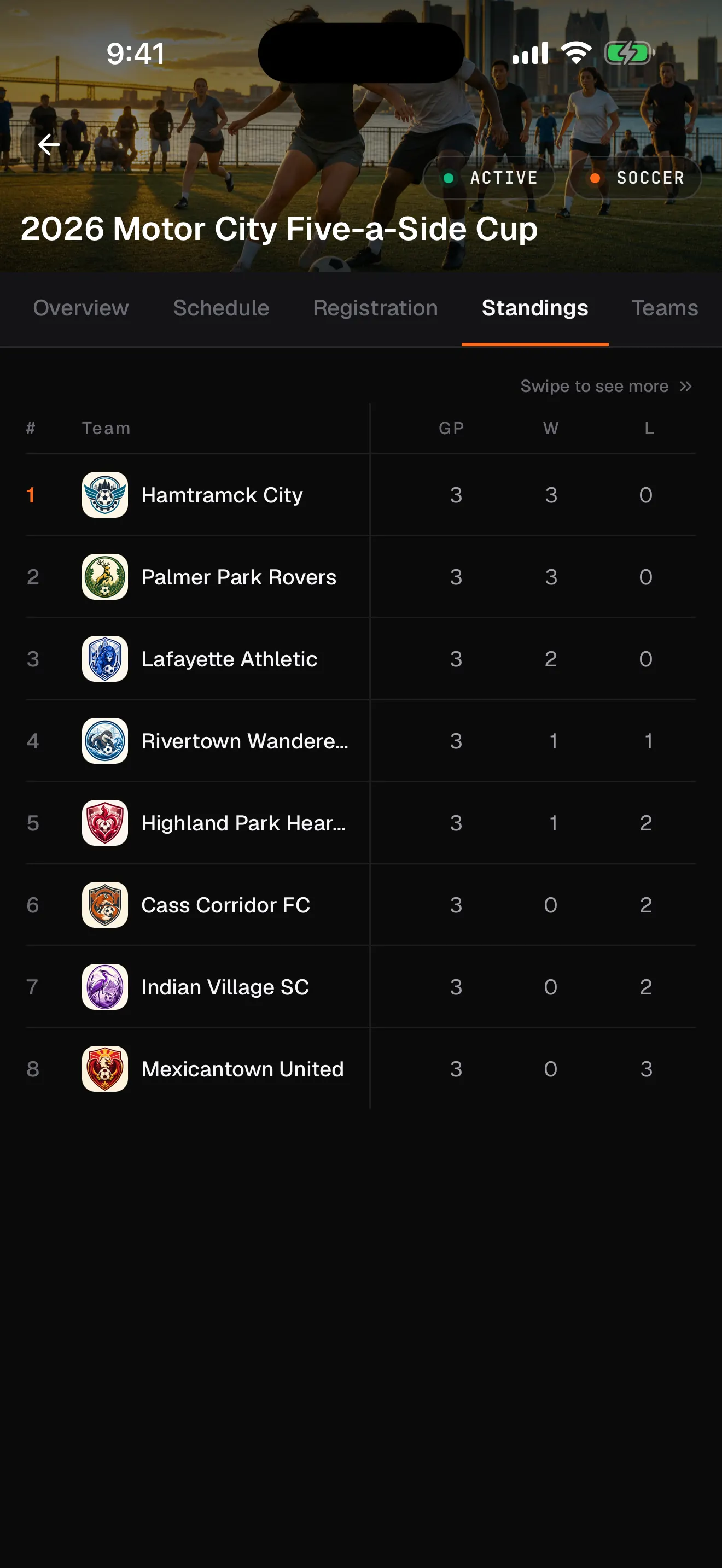
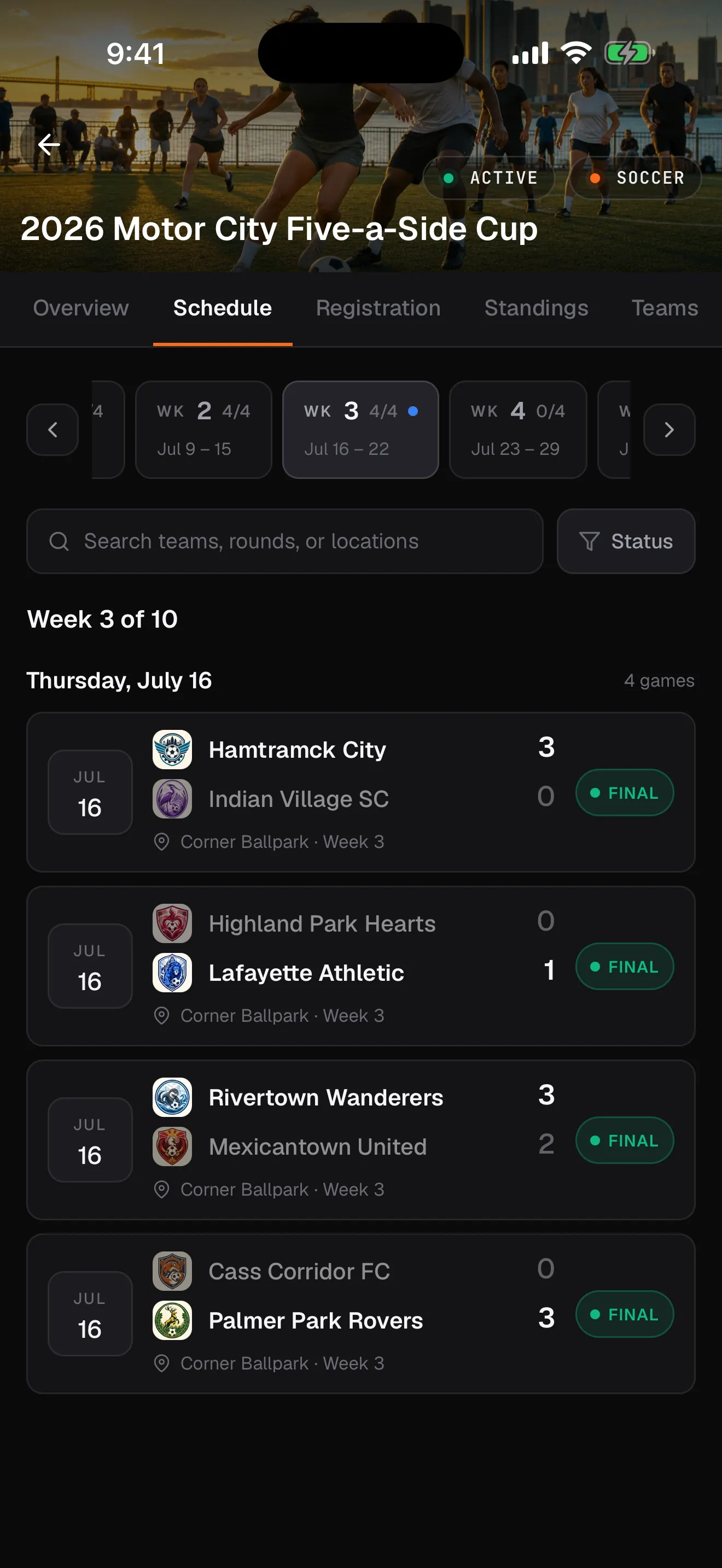
If you want to think that through properly before your first night, the tiebreaker ladder is worth ten minutes: standings, tiebreakers, and playoff seeding.
Step 5Divisions people self-select honestly
Volleyball has the widest skill spread of any rec sport, because a player who can jump serve and a player who cannot pass a free ball can both reasonably call themselves intermediate. Vague division names get you 6–0 blowouts in week one and dropped teams in week three.
| Division | Say this instead | The real test |
|---|---|---|
| A / Competitive | Three contacts every rally, run plays, jump serves | Everyone can pass a serve to target |
| B / Intermediate | Usually three contacts, some hitting, learning systems | Most rallies have a set and an attack |
| C / Recreational | Getting it over in two or three, fun first | Everyone knows the rotation, mostly |
| Beginner | Learning to serve and pass, no experience needed | New players should feel welcome here |
Describe what a rally looks like, not how good a team is. Captains self-select accurately against a behavioral description and inaccurately against a letter.
Step 6Teams, free agents, and subs
Volleyball rosters churn more than any other rec sport, because six people have to be in the same gym at the same time on a weeknight. Plan for churn instead of being surprised by it.
The pricing side of that — per player versus per team, deposits, and collecting without chasing anybody — is covered in what to charge for your league.
Take full teams and free agents through the same form, place subs, collect per player, and see who has actually paid before the first serve.
Step 7Running league night
A volleyball night with three courts and twelve teams can be completely self-running, or it can be you standing in the middle of the gym shouting court assignments. The difference is about four decisions.
- Post the night's schedule with court numbers before people arrive, not on a clipboard at the door.
- Use a horn or a single loud timer for all courts at once. Staggered courts drift and never recover.
- Make the losing team of the previous match take the net down or set the next one up — a small, fair, universally understood tax.
- Self-officiate with an agreed standard: call your own net and lift, replay anything genuinely disputed, and never argue a touch for more than ten seconds.
- Have one person collecting results as matches end. Results collected on Wednesday are results collected wrong.
Self-officiating actually works, with one rule
Recreational volleyball is one of the few sports where players calling their own game is normal and fine. The rule that makes it work is that a disputed rally is replayed, not argued. Say it at the captains meeting, print it on the schedule, and enforce it once. After that it enforces itself.
Before week oneLaunch checklist
Everything above, in the order you actually need to do it. Tick as you go — this saves in your browser as you work through it.
Volleyball league launch
0/14 doneQuestions organizers ask
What net height should a co-ed league play?
How many balls do I need?
Do I need referees?
Can players play on two teams?
How long should the season be?
The short version
- Co-ed 6s for season one; add 4s or reverse co-ed once you know your players.
- Write the ratio as a minimum with a playing-short clause, never as a split.
- Book the gym for setup and teardown, not just for volleyball.
- Cap the sets. A format that cannot finish on time is not a format.
- Rank on set wins with points scored as the first tiebreaker.
- Describe divisions by what a rally looks like, not by letters.
- Run a real free agent list and place everyone on it.
- Disputed rallies get replayed, not argued — say it once, in week zero.