
In this guide · 7 sections
Every league argument in week ten is really an argument about a rule nobody wrote down in week one. Three teams finish 7–3, two of them can make a case for the top seed, and whatever you decide now looks like you decided it because of who asked.
The fix costs an hour before the season starts: pick how standings are scored, publish the tiebreaker ladder in order, and make sure the last rung is something that can never tie.
Step 1Win-loss or a points system
The first decision is what a standings table is even counting. In most rec leagues, win-loss is right and anything cleverer is a liability. But three situations genuinely call for a points system.
| System | How it works | Use when |
|---|---|---|
| Win-loss | Sort by wins, then by the tiebreaker ladder | Basketball, flag football, most court sports |
| Points (3-1-0) | 3 for a win, 1 for a draw, 0 for a loss | Any sport where draws are possible — soccer, hockey |
| Points with a bonus | 3 for a win, plus 1 for a shutout or a scoring threshold | When you want to discourage a team from parking the bus |
| Set or game wins | Count sets won rather than matches won | Volleyball, pickleball, tennis — anywhere matches can split |
| Win percentage | Wins ÷ games played | Leagues where teams end up playing different numbers of games |
Sportsmanship points, honestly
Plenty of social leagues add a sportsmanship score to the standings. It can work, and it fails in one specific way: if it is scored by the opposing captain, it becomes a weapon by week six. If you want it, have the official score it, cap its influence so it can never outweigh a win, and use it as a tiebreaker rather than as points.
Step 2The tiebreaker ladder
A tiebreaker ladder is an ordered list of rules applied one at a time until the tie breaks. The order matters more than the contents, and the bottom rung matters most of all.
A ladder that can still end in a tie is not a ladder, it is a list of suggestions. The bottom rung has to be something mathematically incapable of ending level.
Try itBreak a three-way tie
Here is the exact situation that causes the argument. Three teams finished 7–3. Reorder the ladder, add and remove rules, and watch the seeds move. Every ordering below is defensible — which is precisely why you have to pick one in advance.
Break a three-way tie
InteractiveThree teams finish 7–3. Order your tiebreakers and watch the seeds change — this is exactly the argument you are trying to prevent.
Add a rule to the bottom of the ladder:
behind on fewest points allowed
behind on point differential
| Team | H2H | Diff | PA |
|---|---|---|---|
| Hornets | 1–1 | +48 | 611 |
| Rivermen | 1–1 | +31 | 640 |
| Bricklayers | 1–1 | +48 | 598 |
Head-to-head first is the fairest-feeling rule and the one most likely to leave you still tied. Whatever you pick, the ladder has to end in something that can never tie.
Step 3Why three-way ties break people
Two-team ties are easy. Three-team ties are where badly written rules fall apart, because most leagues never say what happens after the first team is separated.
- Apply each rung to all tied teams at once, as a mini-table — not as a series of two-team comparisons.
- The moment one team is separated, they take their seed and leave the group.
- Then restart the ladder from rung one for the teams still tied. This is the sentence almost every league forgets to write.
- Repeat until every team has a seed.
| Situation | What people do | What to do |
|---|---|---|
| Three teams tied, one separates | Keep going down the ladder | Restart the ladder for the remaining two |
| All three beat each other once | Argue about it | Head-to-head is tied — move to the next rung |
| Unequal games played | Compare raw wins | Compare win percentage |
| One tied team forfeited a game | Treat it as a normal loss | Say in advance how a forfeit scores in differential |
Step 4Forfeits, defaults, and ineligible players
Forfeits distort standings more than anything else in a rec league, and almost nobody writes the rule until the first one happens.
- Score a forfeit with a fixed result. Something like a 1–0 or 20–0 win, recorded identically every time. It keeps point differential honest and it stops a forfeit from being worth more than a real win.
- Say whether a forfeit counts toward differential at all. The cleanest answer is that forfeits count in the record but not in any points-based tiebreaker.
- Publish a forfeit clock. Game time plus ten minutes, and a team that can field a legal lineup gets the win. It takes the decision away from the sideline.
- Decide what an ineligible player costs. The standard is that the game is forfeited retroactively. It is harsh, it is fair, and it only ever has to be applied once.
- Two forfeits should trigger a conversation, three a review. A team that cannot field a lineup is a schedule problem for everyone else — better to help them merge or withdraw than to have four teams play a ghost.
Step 5Playoff seeding and reseeding
The standings exist to produce a playoff bracket. Make that connection explicit before the season so nobody is reading the rules for the first time in week ten.
Once the seeds are set, the bracket itself has its own set of decisions — byes, format, and whether losers get a second game. Those are covered in how to make a tournament bracket.
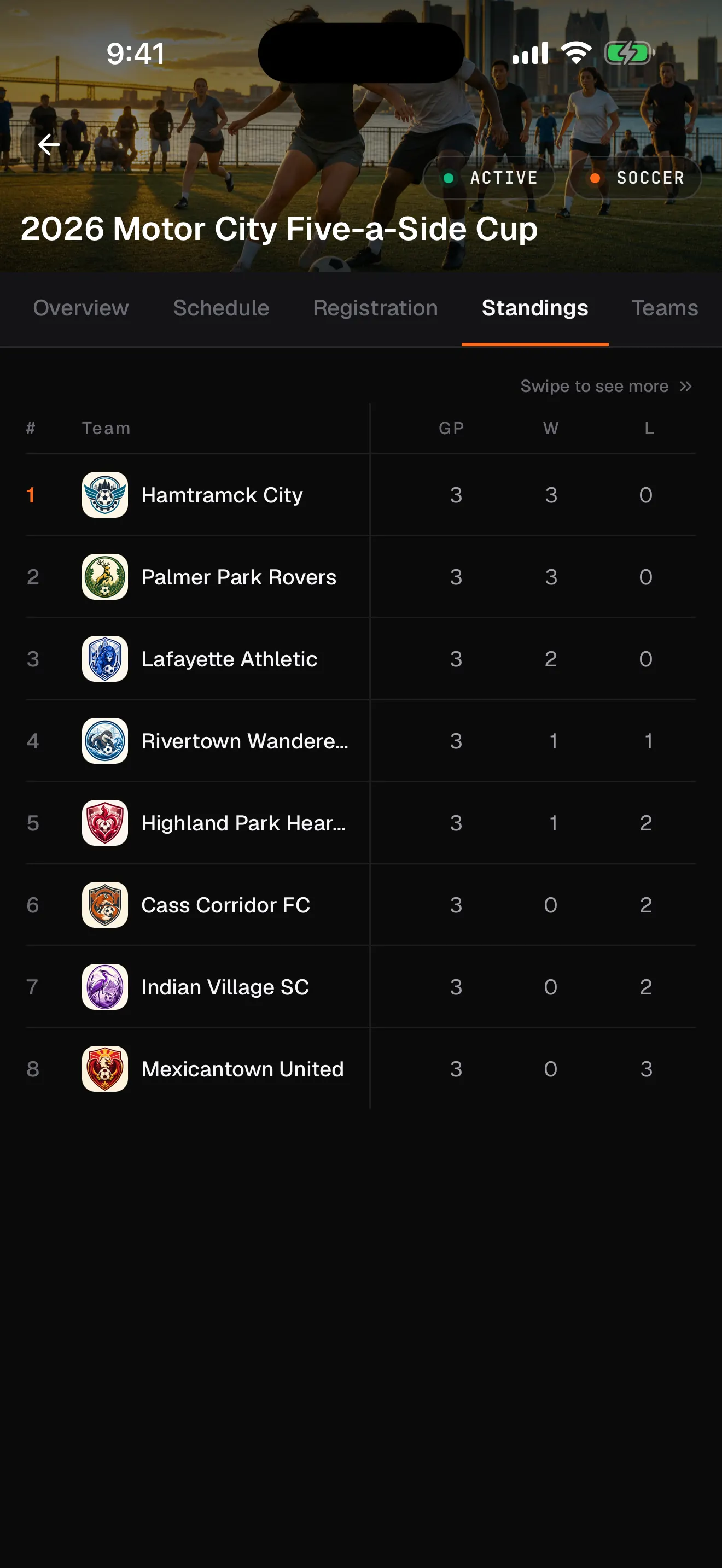
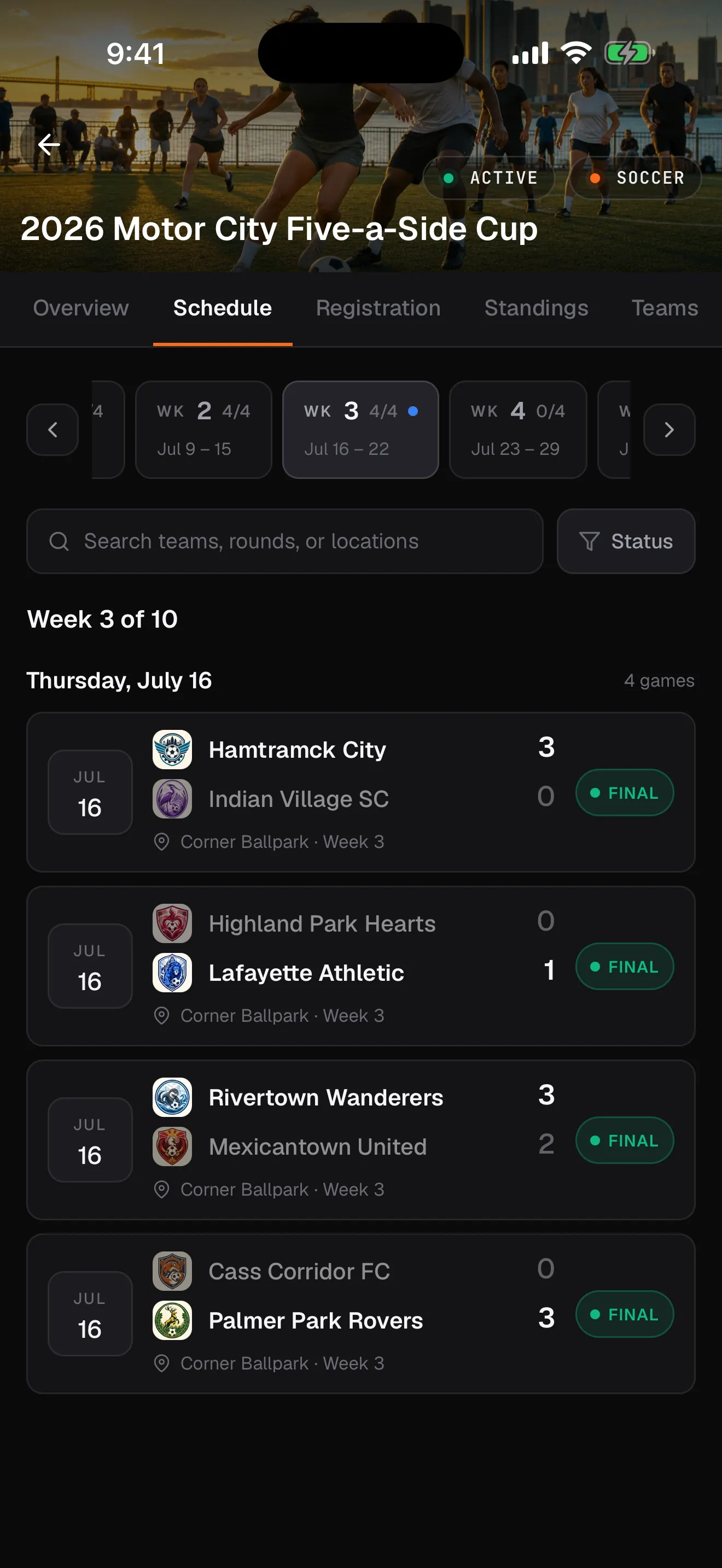
Results feed the table the moment a game ends, tiebreakers apply automatically, and the playoff bracket seeds straight out of the final standings.
Step 6Publish it before week one
Every rule above is worth nothing if the first time a captain reads it is after it went against them. Publishing early is not a formality — it is the entire mechanism by which a rule stops being your opinion.
- Put the standings system and the full tiebreaker ladder on the league page, in order, numbered.
- Say how many teams make the playoffs and how they are seeded.
- State the games-played minimum for playoff eligibility.
- State how forfeits are scored and whether they count toward differential.
- Send it to captains in the week-zero email as well. On the page is available; in the inbox is delivered.
- Never change it mid-season. If a rule turns out to be wrong, say so publicly, note it, and change it for next season.
Questions organizers ask
Head-to-head or point differential first?
Should a forfeit count as a win for differential?
Can I just decide seeding as the organizer?
What if two teams did not play each other?
How do I handle a tie at the bottom of the playoff cut?
Do I need tiebreakers if we run playoffs anyway?
The short version
- Win-loss for most sports; win percentage the moment games played differ.
- Publish the ladder in order, numbered, before week one.
- Head-to-head first, differential beneath it, capped so nobody farms margin.
- The last rung must be something that cannot tie — a public draw is fine.
- In a three-way tie, separate one team, then restart the ladder for the rest.
- Give forfeits a fixed score and keep them out of differential.
- Seed the bracket straight from the table. No committee, no discretion.
- Set a games-played minimum for playoff eligibility before anyone needs it.