
In this guide · 9 sections
Almost every rec basketball league that dies in its first season dies for the same reason: the organizer solved the fun problems first. They picked a name, made a logo, started a group chat, and only later found out the gym is booked on Tuesdays through March and four of the eight “definitely in” teams never actually paid.
The order matters more than the effort. Below is the sequence we'd run if we were starting a league from zero on Monday morning — what to decide first, what numbers to check before committing, and the eight-week countdown to your first tip-off.
Step 1Decide the format first
Format is the decision every other decision hangs off. It sets your gym hours, your fee, your roster sizes, and how many teams you need to recruit. Pick it before you tell a single person the league exists.
Three questions get you there:
- 5v5 or 3v3? 5v5 is what people picture, but it needs 8–10 players per roster to survive absences and a full court for 40+ minutes. 3v3 needs 4–5 per roster, runs on half courts, and lets you fit twice the games into the same booking. If your gym time is thin or your player pool is under 60, start 3v3.
- Team registration or free-agent draft? Team registration is far less work — captains recruit for you — but it caps your growth at however many organized friend groups exist nearby. A draft league is more admin and produces much better competitive balance. Most healthy leagues run both: teams register as units, and unattached players go into a free-agent pool that fills out short rosters.
- How competitive?Be explicit and put it in writing. “Recreational, no refs, call your own fouls” and “competitive, two officials, FIBA rules” are different products with different prices and different customers. Trying to serve both in one division is how you end up mediating an argument at 9:40 on a Tuesday.
Step 2Lock the gym before anything else
Gym availability is the hard constraint. Everything else in your league is negotiable; the number of hours you can get on a consistent weeknight is not. Book it before you announce anything, and book more weeks than your season needs.
Where the time actually is, roughly in order of how likely you are to get it:
- Parks & rec community centers.Cheapest, most likely to have a permit process, and usually booked out one to two quarters ahead. Ask about the “league rate” — it's often lower than the drop-in hourly rate.
- School gyms. Great courts, painful process. You are negotiating with a facilities coordinator, not an athletics director, and you will need a certificate of insurance. Start in spring for a fall season.
- Churches and community halls. Wildly underused weeknight capacity. Shorter courts, sometimes no shot clock, often the friendliest terms you will find.
- Private facilities and sports domes. Instantly available, two to four times the price. Good for filling a playoff week when your regular gym has a school event.
Do the slot math before you sign
A two-hour block does not mean two hours of basketball. Budget five minutes for warmups and changeover between games and you get a clean picture:
| Booking | Game format | Games per night | Teams supported |
|---|---|---|---|
| 2 hours, 1 court | 2 × 20 min halves | 2 | 4 teams/night |
| 3 hours, 1 court | 2 × 20 min halves | 3 | 6 teams/night |
| 2 hours, 2 courts | 2 × 20 min halves | 4 | 8 teams/night |
| 2 hours, 1 court | 3v3 to 21 | 6 | 12 teams/night |
Running clock except the final two minutes keeps a 20-minute half at 20 minutes. Stop-clock all game turns two hours into two and a half.
Step 3Build the budget backwards
You do not pick a fee. You calculate one. Add every cost for the whole season, divide by the number of players you expect, then round up to the next $5 and add a cushion. In that order.
| Line item | Typical range | Notes |
|---|---|---|
| Court rental | $40–$120 / hour | The single biggest line. Lock the rate in writing. |
| Officials | $30–$50 / official / game | Two per game for 5v5. Optional for casual 3v3. |
| Insurance | $250–$700 / season | Most facilities require a COI naming them. |
| Jerseys or pinnies | $15–$30 / player | Pinnies once, jerseys every season. |
| Balls, scoreboard, first aid | $150–$300 one time | Buy two game balls, not one. |
| Payment processing | ~2.9% + $0.30, plus platform fee | On every registration you collect online. RecTrack adds 2% on top of Stripe's fee. |
| Championship gear | $100–$250 | Shirts or a trophy. Worth every dollar for retention. |
For a typical first season — 8 teams, 9 players each, 10 weeks, one court at $60/hour with two officials per game — you are looking at roughly $2,400 in court time, $2,800 in officials, and about $600 in gear and insurance. That's ~$5,800 against 72 players, or about $80 per player just to break even. Charge $95–$110 and you have a real buffer.
Step 4Open registration properly
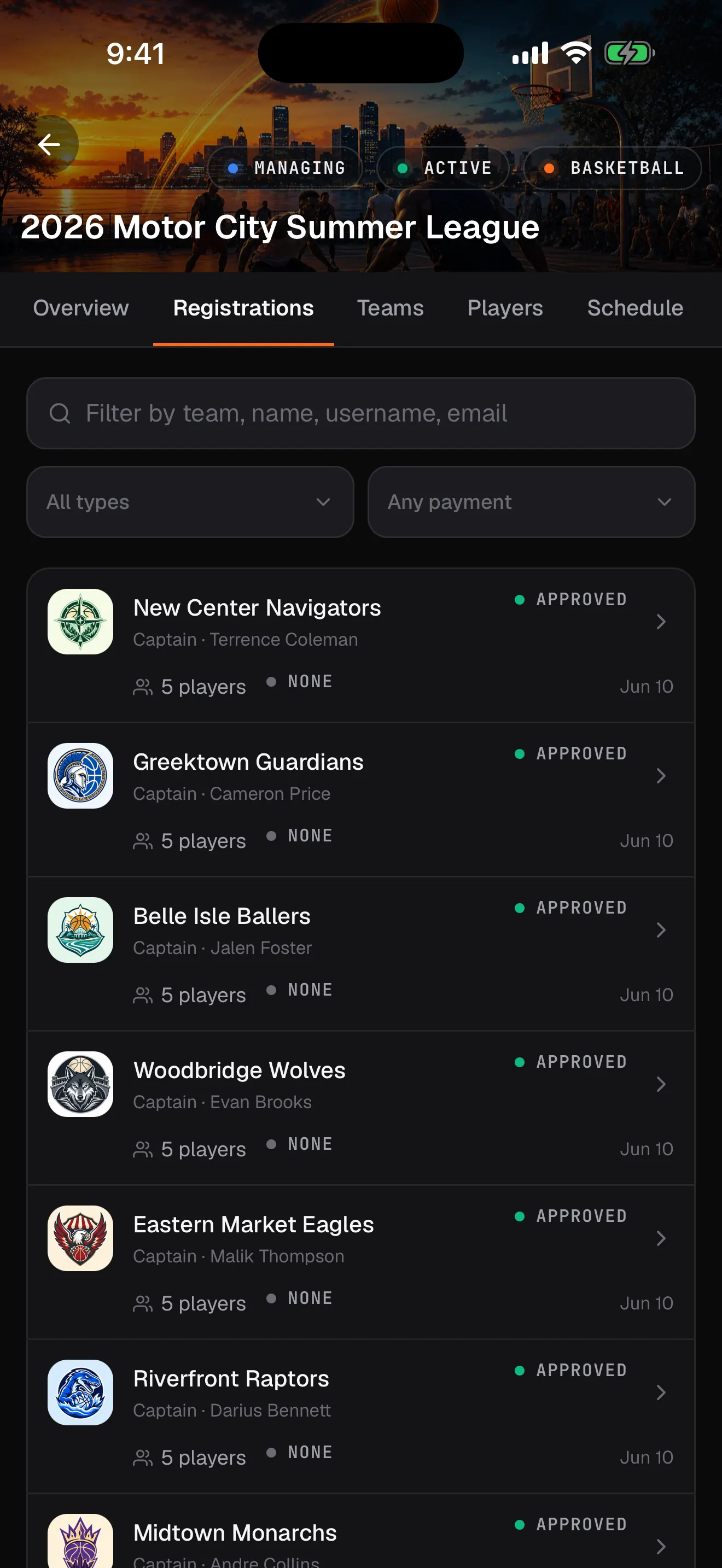
Registration is where most leagues quietly lose a third of their interest. Someone hears about the league, wants in, and then hits a Google Form that asks for their address, a Venmo request from a stranger, and a group chat invite. Each step is a place to drop out.
What a registration flow needs to do, in one link:
- Show what they're signing up for — dates, nights, location, format, price — before asking for anything.
- Collect the roster or let a captain add players later without re-entering everything.
- Take payment at the moment of commitment, not two weeks later by text.
- Collect the boring-but-critical fields: emergency contact, jersey size, waiver acceptance, date of birth if you have any age rules.
- Send a confirmation the player can find again in three weeks when they've forgotten what time the game is.
Every extra step between “I'm interested” and “I paid” costs you teams. The link you share should end in a receipt, not in a to-do list.
Set a registration deadline about ten days before your first game and publish it. Not because you'll enforce it rigidly — you'll take a late team if it makes the bracket even — but because a deadline is what converts “yeah we're in” into an actual payment. Without one, half your teams register the night before.
Step 5Rosters, captains, and free agents
Your captains are your actual operations team. Eight captains who know what's expected of them is worth more than any amount of software. Give each one a short, specific list:
The free-agent problem
Individual signups are the most valuable and most neglected part of a rec league. They're players with no friend group who will absolutely come back next season if you place them well — and never speak to you again if you leave them in limbo for three weeks.
Two workable approaches:
- Distribute them. Keep a free-agent list and assign players to teams with short rosters. Fastest, and it strengthens the teams most likely to forfeit. Tell the player who their captain is within 48 hours of signup.
- Build a house team. Once you have 7+ free agents, make them a team and name a captain from the group. House teams are usually the most fun team in the league and the most likely to re-register as a unit next season.
Step 6Build a schedule that holds
With an even number of teams the regular season falls out of the math: a single round robin with N teams takes N−1 weeks and gives every team the same number of games. Eight teams, seven weeks, four games a night. Ten teams, nine weeks, five games a night.
Three things separate a schedule people like from one they complain about:
- Rotate the bad slot. If your night runs 7:00, 8:00, and 9:00, the 9:00 game is the bad slot. Spread it evenly — no team should have three late games while another has none.
- Avoid back-to-back repeats. Nobody wants to play the same team in weeks 4 and 5. A proper round-robin rotation handles this for free.
- Publish the whole season at once. People plan their lives around this. A schedule released a week at a time produces exactly the attendance problems you were trying to avoid.
Step 7Game night operations
The whole season is judged on how smoothly Tuesday night runs. Nobody notices good operations; everybody notices the ten minutes where nobody knew who was supposed to be on court.
The 15 minutes before the first game
- Arrive 20 minutes early. Unlock, lights, nets, scoreboard, table set up.
- Post the night's matchups somewhere visible — a whiteboard or a pinned message, plus the schedule in the app.
- Confirm officials arrived. Have a backup number for a no-show.
- Check that both teams can be told apart. This is what the pinnies are for.
Scorekeeping is the thing to get right
The paper scorebook is where rec leagues lose their most valuable asset: the record of what happened. Players care enormously about stats, and a notebook that lives in your car produces standings updated on Thursday if you remember.
Whatever you use, aim for three properties: the score updates live so people not in the gym can follow it, stats attach to actual players rather than a tally sheet, and the standings recalculate the moment the game ends. That's the difference between a league and a group of people who booked a gym.
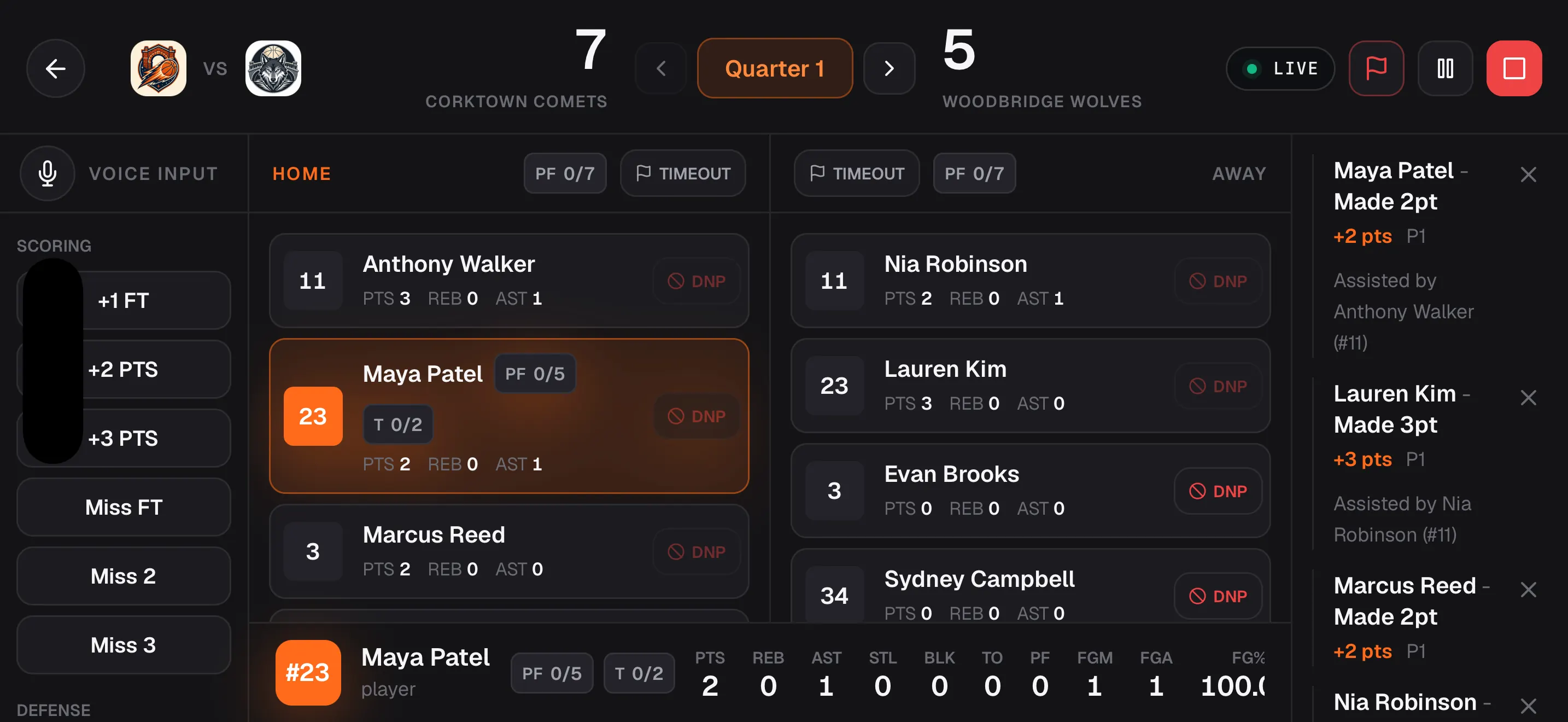
Live scoring, box scores, standings that re-sort themselves the second a game ends, and push alerts to players who weren't in the gym.
Step 8Playoffs and the last week
Get everyone into the playoffs. This is a recreational league; the team that went 1–6 paid the same fee as the team that went 6–1 and deserves one more night of basketball. An 8-team single-elimination bracket runs in two nights: quarterfinals and semis on night one, final on night two.
Publish your tiebreakers before week one. The standard, in order:
- Head-to-head record between the tied teams
- Point differential in games between the tied teams
- Overall point differential (cap it at ±20 per game so blowouts don't decide seeding)
- Points allowed
- Coin flip, in front of both captains
The last night matters more than you think
Championship night is your single best retention moment. Do the small things: shirts or a trophy for the winners, an all-league team you announce from actual stats, a photo, and — this is the important part — open next season's registration that night with a returning-team discount. The room is full of people who just had a great time. That is the cheapest recruiting you will ever do.
Put it togetherThe 8-week countdown
Here's the whole thing as a working checklist. Tap items as you go — it's ordered so that anything that can block something else comes first.
Basketball league launch checklist
0/15 doneLoose endsQuestions that come up every time
How many teams do I need to start?
Do I need referees?
What about insurance?
How do I handle a team that stops showing up?
Should I pay myself?
The short version
- Format first, then the gym, then the fee. Reverse that order and you'll rebuild everything twice.
- Book one week past your final. You will use it.
- Calculate the fee from a cost sheet, then add a cushion — don't pick a number that sounds fair.
- Registration should end in a receipt, not a to-do list.
- Eight captains who know their job is worth more than any tool.
- Publish the whole schedule and every tiebreaker before week one.
- Open next season's registration on championship night, while the room is still full.